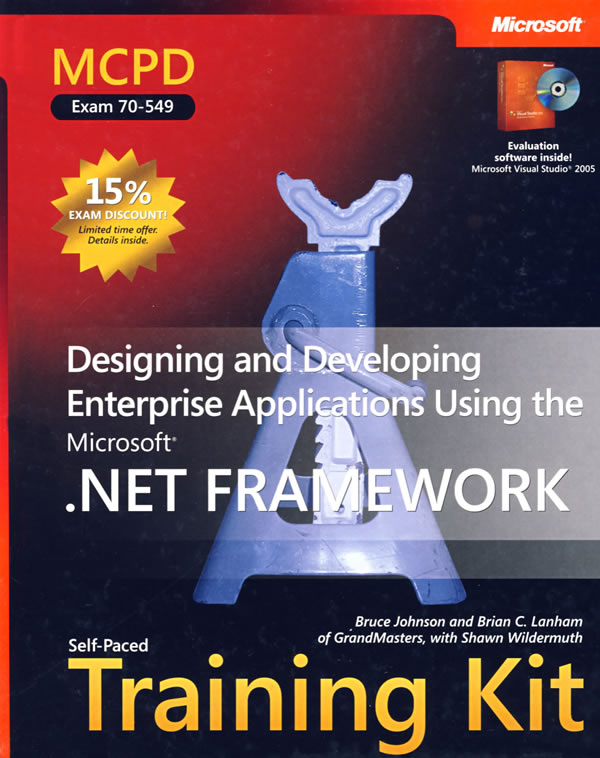
Microsoft .NET Framework 应用之企业应用设计与开发(1-CD;1-DVD-Eval) Designing and Developing Enterprise
 点此进入淘宝搜索页搜索
分類: 图书,进口原版书,计算机 Computers & Internet ,
作者: Bruce Johnson, Brian C. Lanham 著
出 版 社: Oversea Publishing House
出版时间: 2007-3-1字数:版次: 1页数: 527印刷时间: 2007/03/01开本: 16开印次: 1纸张: 胶版纸I S B N : 9780735623385包装: 精装编辑推荐
作者简介:Bruce Johnson,Bruce Johnson is a partner at ObjectSharp Consulting and is a 2f-year veteran of the computer industry. The first half of his career was spent working in the trenches-otherwise known as
the UNIX field. The past 14 years have been spent on projects at the leading edge of Microsoft Windows technology-from Microsoft C++ through the myriad versions of Microsoft Visual Basic and ASP up to the present incarnations in Microsoft .NET Framework 3.0. Bruce's expe- rience includes creating commercial Web applications, implementing Web services in a finan-cial institution, and building Windows Forms applications.
As well as having fun with system design and development, Bruce has given more than 200 presentations at conferences and user groups all over North America. He has written columns and articles for numerous magazines and attempts to write regular posts on his blog at
www.objectsharp.comflblogsflbruce.
内容简介
Announcing an all-new Self-Paced Training Kit designed to help maximize your performance on 70-549, a required exam for the new Microsoft Certified Professional Developer (MCPD): Enterprise Applications Developer certification. This 2-in-1 training kit delivers in-depth preparation plus practice for 70-549. Ace your exam prepand build real-world job skillswith lessons, practice tests, code samples, and more. This official study guide covers topics such as envisioning and designing an enterprise application; designing and developing the applications user interface, components, and framework; testing and stabilizing the application; and deploying and supporting the application.
目录
Introduction
Hardware Requirements
Software Requirements
Using the CD and DVD
How to Install the Practice Tests
How to Use the Practice Tests
How to Uninstall the Practice Tests
Microsoft Certified Professional Program
Technical Support
Evaluation Edition Software Support
1 Evaluating the Technical Feasibility of an Application
Before You Begin
Lesson I: Evaluating Requirements and Proposing a Design
What Makes a Good Set of Application Requirements?
Evaluating the Requirements for the Application
Recommending Best Technologies
Investigating Existing Solutions for Similar Business Problems.
Creating a High-Level Application Design
Lab: Evaluating Requirements and Recommending Technology
Lesson Summary
Lesson Review
Lesson 2: Creating a Proof-of-Concept Prototype to Refine
an Application's Design
What Constitutes a Good Prototype?
Mockups and Proof-of-Concept Prototypes
Creating a Prototype to Evaluate Key Design Decisions
Demonstrating the Feasibility of the Design
Lab: Creating a Proof-of-Concept Prototype
Lesson Summary..
Lesson Review
Chapter Review
Chapter Summary
Key Terms
Case Scenario
Case Scenario: Evaluate Requirements and Propose an Application Design
Suggested Practices
Evaluating Requirements and Proposing a Design
Creating a Proof-of-Concept Prototype to Refine an Application's Design
Take a Practice Test
2 Creating Specifications for Developers
Before You Begin
Lesson 1: Create a Logical Model
Object Role Modeling
The ORM Notation
Driving ORM Diagrams from Requirements and Use Cases
Using ORM Diagrams to Identify Objects, Properties, Methods,
Entities, and Fields
Lab: Create a Logical Model
Lesson Summary
Lesson Review
Lesson 2: Define Application Layers
Define the Layers of Your Application
Define Communication Between Layers
Lab: Define Logical Application Layers
Lesson Summary
……
3 Design Evaluation
4 Component Design
5 Component Development
6 Multimedia in Distributed Applications
7 Reusable Software Components
8 Design Logic Implementation
9 Logging and Monitoring
10 Planning for Testing
11 Unit Testing: The First Line of Defense
12 Stabilizing the Application
13 Evaluating Application Performance